



Switching to E10 Gasoline: Notes for Vehicle Owners
28/05/2026 17:08:12From June 01, 2026, E10 biofuel will be officially deployed simultaneously nationwide, replacing RON 95 and E5 RON 92 gasoline according to Circular No. 50/2025/TT-BCT of the Ministry of Industry and Trade, directly affecting tens of millions of vehicles currently in circulation in Vietnam.
If you are wondering “Can my vehicle use E10 gasoline?” or “What do I need to prepare before this change?“, the article below from JACCS Vietnam will provide you with the most comprehensive overview.
What is E10 Gasoline? Why the Switch?
E10 gasoline is a biofuel blended from 90% mineral gasoline and 10% ethanol, an alcohol derived from agricultural products such as sugarcane, cassava, and corn. This is not a new technology, as countries like the US, Thailand, and Brazil have used E10 for decades without recording widespread engine damage.
Promoting the use of E10 gasoline is part of Vietnam’s long-term strategy to reduce dependence on fossil fuels, cut greenhouse gas emissions, and move towards the goal of net-zero emissions by 2050.
Is Your Vehicle Compatible With E10 Gasoline?
The Ministry of Industry and Trade confirms that E10 gasoline is compatible with more than 90% of vehicles in circulation and requires no engine modifications.
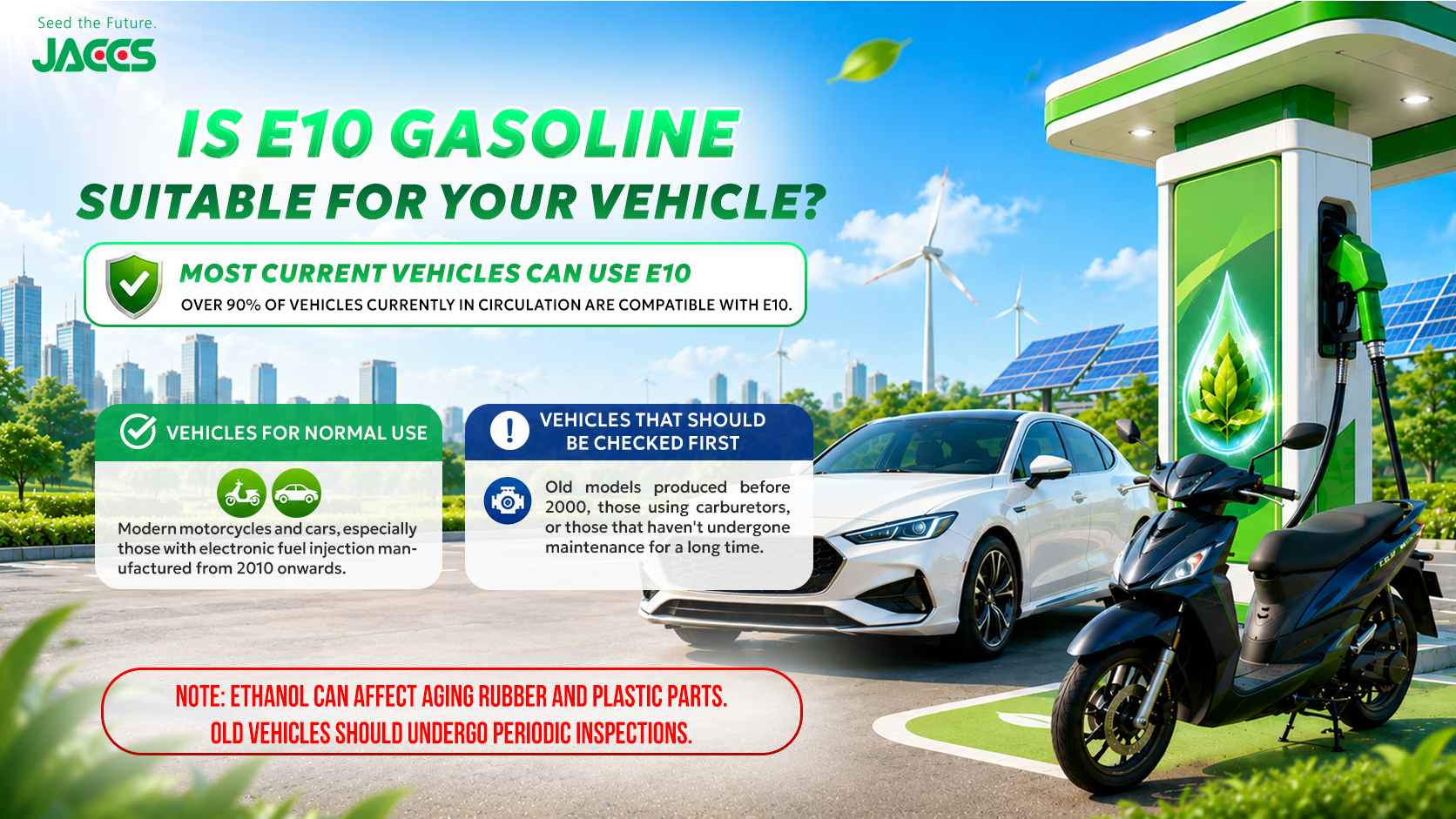
• Vehicles for normal use: Most cars and motorcycles from 2010 (especially the Electronic Fuel Injection – FI lines) have been designed to be fully compatible with E10 gasoline. The Vietnam Association of Motorcycle Manufacturers (VAMM) confirms that vehicles from its member brands all use this type of fuel well. Users can check the instruction manual further for complete peace of mind.
• Vehicles needing careful inspection: For older vehicle models, especially those manufactured before the 2000s, E10 gasoline can denature, deform, or corrode rubber hoses, plastic parts, rubber gaskets, and seals. Vehicles using carburetors are mostly incompatible with ethanol—when this fuel decomposes, it leaves varnish-like deposits inside the carburetor, significantly reducing operating performance.
Practical Notes When Switching to E10 Gasoline
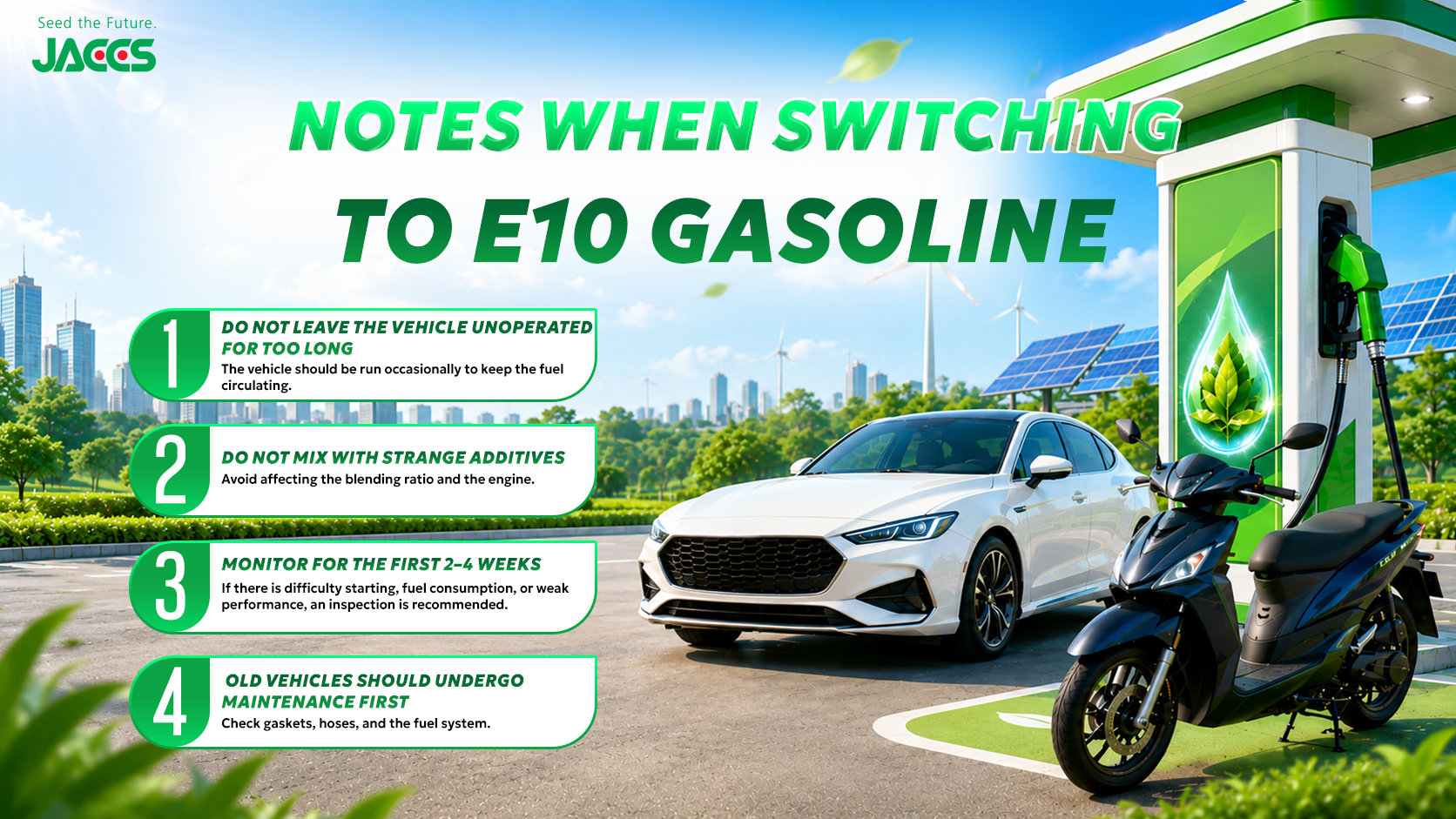
1. Do not leave the vehicle unoperated for too long: E10 biofuel easily absorbs moisture and causes stratification if the vehicle is left for 3 – 4 weeks. Therefore, instead of just starting the engine in place for a few minutes, owners should operate the vehicle on the road long enough for the fuel to circulate and the engine to warm up.
2. Do not add additives of unknown origin: E10 gasoline has been blended to standard. Adding additives of unknown origin (such as “ethanol separators”) has no scientific basis, easily unbalances the fuel ratio, and poses risks to the engine.
3. Monitor the vehicle for the first 2 – 4 weeks: Prof. Dr. Pham Huu Tuyen notes that particularly with older vehicles, ethanol has the effect of cleaning long-term deposits in the fuel system – this is beneficial in the long run, but in the initial stage, it may cause the fuel filter to become clogged.
4. Old vehicle models should prioritize maintenance before June 01: Check rubber gaskets, hoses, and the carburetor. Typical costs are around 200,000 – 500,000 VND, which is completely reasonable for the vehicle to run stably in the long term.
Quick Q&A for Vehicle Owners
Question: If there is still RON 95 (E95) gasoline left in the tank, can I pour E10 gasoline directly in, or do I have to flush the tank?
Answer: According to the Ministry of Industry and Trade, the mixture of remaining mineral gasoline and E10 does not cause harmful chemical reactions, and it will gradually be completely replaced after the next few refuels.
Question: Does using E10 gasoline consume more fuel than traditional gasoline?
Answer: Many domestic and international studies show that the fuel consumption of E10 is basically equivalent to mineral gasoline under normal operating conditions (Source: PetroTimes, 05/2026).
Question: Does E10 gasoline cause harm to the vehicle’s engine?
Answer: The Ministry of Industry and Trade maintains that E10 gasoline does not cause harm to the engines of the vast majority of current vehicles – except for some old models before 2000 that use incompatible natural rubber materials.
Is This a Good Time to Switch to a New Vehicle?
If your vehicle still operates well after maintenance – there is no need to rush to change it.
However, when repair costs increase or the vehicle frequently encounters errors, it is a reasonable time to consider an upgrade. New vehicles are not only fully compatible with E10 but also meet the trend of using biofuels like E15 and E20 in the future – a long-term investment for both the economy and the environment.
JACCS Accompanies You on the Journey of Innovation
To make vehicle upgrades easier, JACCS Vietnam offers flexible financial solutions, helping you proactively own a new vehicle and stay ahead of the green fuel trend with reasonable costs:
• Preferential interest rates for customers purchasing motorcycles or cars on installments at JACCS’s partner system nationwide.
• Digitalized procedure process, saving time.
• Quick approval right at affiliated dealers.
• Flexible installment terms, making it easy to balance your finances.
For detailed information, please contact:
📞 Hotline: (028) 7108 6999
📬 Zalo OA: JACCS Việt Nam (Official account with gold verified tick)
🌐 Website: JACCS Việt Nam
🔗 Facebook: Công ty Tài Chính JACCS Việt Nam
Other News



 22/05/202609:00:04